So, this is approximately late August or early September in Idaho- I honestly don't remember the date. I am a fat delusional 19-year-old who's spending his waking hours reading books, lifting weights, and playing video games, going to his first ever house party where I am served alcohol.
Needless to say, I went a little nuts.
So the party goes off, the guy who brought me disappears- apparently out into the hills to get drunker and fight with whoever wanted a go, but I can only vouch for the guy ever getting drunk in my presence. I, unaware of what being drunk feels like, continue to drink well after that point. In the course of an evening, a large bottle of vodka mostly disappears, and one of my last clear memories is of taking a large swig toward the bottom of that bottle, having done my share to help put away most of it, and some whisky, everclear, gin, kalua, bourbon, and probably other things that were lost on me at the time.
After that, the next thing I remember is coming to in the hospital and apologizing profusely to the nurses and saying "you guys should really be helping people, not dealing with this shit". Shortly thereafter, the humiliation intensifies as my dad shows up with his friend, who was at the time my jujitsu instructor, and who was coaching me in physical fitness, and he's this brilliant engineer with a ton of patents and all this shit. I didn't put such words to it at the time, and it was certainly nobody's intention to do this, but part of the cringe factor of looking back on an event like this comes from being at your lowest and most humiliating low- the drunk underage idiot evicted by ambulance from a friend's house party, and my dad shows up with this guy who's a huge role model really made me painfully aware of how badly I'd fucked up.
One of those situations. But I was really surprised by how quiet the guy was. Looking back I suspect he has his own perspective on benders, but he's a boisterous, rambunctious gregarious guy, and so his quietness seemed odd that day.
Anyway, that day wound up being the 24 hours to sober up my dad gave me- I think I sarcastically counted out the 30 hours it took for an actual conversation to happen- and then my Dad sat me down in the living room, and I think my mother was also there but my memory isn't perfect, and he said "OK, so this was a cry for help". And he proceeded to explain how my Aunt, his sister, could take me on for a year if I were going to art school there, which seemed like a good option at the time, as I'd just, in a few months, been fired from a lucrative industrial photo editing job I had1, and had given up on the degree I'd pursued for a few semesters at a local college- game design2.
So, on the basis of moving further away, I chose Thailand. Which entailed being a missionary- and I, as a frustrated "athiest", said "fuck it" and decided it was better to be an atheist missionary than a 19 year old living in his parent's back yard shed. One of the amazingly frustrating and condescending shitty things that drove that was being banned from a forum where I was admittedly an ass, but partly on the basis that the people there took me to be a Christian troll, when I was genuinely- if stupidly- an atheist and on their side and just not up to speed. Because my upbringing had left with lots of really severe science denialist bullshit, which in retrospect seems more the result of the environment my parents chose for me, rather than anything to do with the views of my parents themselves.
Why a missionary? why that? Well, it was something my parents came up with as what they thought was a good opportunity, because my mom's younger brother, of course, had married a Thai nurse who was going to the Laotian church he attended near his house, her younger rabidly Christian brother wanted a white person to come help his missionary friends3 teach English.
This point bears examining for some people; Thailand is a country that is a study in contradictions, and one of those contradictions is the idea that while Thailand, that is, the Thai people culturally, as I interacted with them, would utterly reject the notion of justifying anything on the basis of race, but still point to the darkness of the skin of criminals (never mind that it is the same darkness of skin as the majority of the Thai population!)- the correlation is not so much that anybody is better by birth, but that if you are less educated, less looked after, your skin gets darker because you work in the sun more. This bias is leveraged by their culture, in their famous hospitality, as a more or less universal "benefit of a doubt" that is more easily granted to lighter foreigners than darker ones- Thai people have had no shortage of interactions between all of civilization between the pacific and Indian oceans, as Thailand, for approximately the last 700 years4.
In practice, this means that Thailand is, or at least can be, an easy place to integrate for lighter skinned people, and indeed, historically and today this has been and continues to be borne out- there are more Thai-Chinese families, where Chinese men5 have married Thai women, than there are in neighboring countries like Laos, Cambodia, Malaysia, Burma, and so on.
White people end up with a similar bias- maybe it has to do with the history of colonialism in southeast asia, and the resistance to it by Thailand6, Whatever the origin of it is, the generic stereotypical perception, by Thais of westerners, is that they are, or at least have the chance to be, well educated, fabulously wealthy, and that for all this we tend to be a bit oafish and clumsy with the expected social niceties, and so charity must be granted to us for our differences in order to properly accommodate a relationship that might become beneficial.
But nonetheless, we speak English natively, and being able to communicate with us is a solid cachet of points in the pecking order of Thai society, and so there is always a demand for white native English speakers. Particularly, since Thai society is rather sexually conservative, and the appetites of foreign men have led to an entirely different reputation abroad, for white native English speaking women, who won't try to fuck all the teachers and janitors at a given school that hires them quite so often as the white native English speaking men seem to.
As a white guy, ostensibly a missionary- I was, again, an atheist, but not "out" to my family, I wasn't quite a white woman, but being a missionary- as long as you're relatively straightforward about that, and I was- is considered a pretty good second best, at least by the sort of people without better options, who don't know better, or who are otherwise Christian themselves already.
And so my adventure began, about a month after that hangover, with a 30 hour plane ride to no bed, no air conditioning, no heated showers, no toilet paper, no sitting toilets, and no food that was available to be had in any language I spoke. I promptly enrolled in a Thai language school and began rapidly acquiring Thai, getting my bearings, and learning my way around. two weeks after I landed, I was told by that missionary family I was supposed to teach English with that "We don't want you, you speak too fast."
And I was cut loose to do nothing and find my own way.
Sometimes I wonder what my life would have been if I'd left those idiots and done something besides study theology.
1 - - - - In the course of processing hundreds of images, I processed things faster than anybody they'd ever seen, but with an error rate that was unacceptable
2 - - - - Because the coding, in Visual Basic 6 and in preparation for Visual Basic.Net, was too painful. I have never quite forgiven Microsoft for what it did to Basic as a result, and that debacle itself turned into one of my earliest sequential forrays into the discipline of programming- but that's a story for another day. Suffice it to say,
there once was a language called Basic,
It was a marvelous script to write pong <sic>,
When in Microsoft trucked,
and the other scripts ducked,
And Basic was Basically™ fucked.
3 - - - - a North Korean-American family, and literal cousins to the Kim dynasty
there. Fitting, kind of. It sheds a lot of light on the country when
you learn that the leading monarch/godhead was a protestant preacher's
kid, and that there's still a continuing successions of preachers kids with their own cult outside those borders.
4 - - - - Perspective, is about the age of the kingdom AND the time that
one of it's dynasties- at the time, I think it was siriyothai- first
established formal relations with Korea, a years-long nautical voyage
away. Formal relationships ended during the warring states period in Japan, because neither country could get ships around what was the Japanese pirates on one side, and the Mongolian and Chinese on the other, but this perspective has led me to ask the question: Is kimchi the Korean recreation of Som Tam, as it would be after a years-long nautical journey to a foreign land during the iron age? Is it, in fact, a faithful korean recreation of a highly esteemed but perishable foreign delicacy? It fucking isn't, but now all the white people reading this are googling both those things, all the Thai people are laughing and all the Koreans are saying "What the fuck is Som Tam?"
5 - - - - This one is a weird historical detail,
particularly, since Imperial China didn't allow women to travel, in
order to anchor its male citizens to China by family, which is why Chinese men being able to marry outside of China at all was a big deal- just think about how unpopular they were in your country at the time, and then ask how many of them were getting laid.
6 - - - - Really, the use, by France and England, of Thailand as a 'buffer state' between French Indochina and the British Indian Territories, which at the time, extended East into Burma, making Thailand a natural border between the two colonial empires, and sparing Thailand an ugly share of the most disgraceful histories of those two states
Thursday, September 22, 2016

Wednesday, September 21, 2016
What is an Earthship, and why should I give a shit?
So, what is an Earthship?
An Earthship is a house.
It's a house that requires no power to run, which produces food, heats and cools itself, collects rain water for drinking water, and treats the sewage that is the byproduct of human use of that water and food. In this way, above and beyond merely being houses, Earthships are highly engineered passive human-sustaining habitats.


But houses already exist! All of these problems already have solutions, most or all of which are still accessible! Why does this matter at all?
Because Earthships can be made to do this in any environment on earth, using locally sourced materials that are normally considered garbage, such as discarded cans, bottles, and tires. Thus, they not only represent an emerging technology set that can and will outcompete our current house building technology, they are a sustainable solution, and one that is deliverable as humanitarian aid, for maximum benefit, with minimum investment.

Earthships are beautiul state-of-the-art homes which require little or no infrastructure and have little or no overhead. Made of garbage.
So, the above portion is largely rhetoric, and not actionable or useful, so here I'll describe a 'basic' earthship and list examples of this set of technology in action and explain some of the points about it.


What does an earthship look like? Any house can look like an earthship, but there is a 'classic' model that most draw elements from. Earthships are always oriented to use the sun, and so in the northern hemisphere face south, and in the southern, north. The sun-facing sides are usually built as green houses with solid stone or rammed earth floors to catch the heat from the sun in a deliberately warmed portion of the house. At the top of these green houses are vent windows that allow hot air to blow out. Behind the greenhouse portion is the house proper- these are typically long linear structures built into the side of a hill, with tire walls forming the outer boundary and smaller dividing walls inside to allocate the space into rooms. Over the top is a typically shallowly sloped roof, also typically covered in sheet metal painted a single coherent color (as a cheap, efficient, durable, light, and non-contaminating way to funnel the rain water into the collection system), which are typically on the north (in the northern hemisphere) side of the house, but which can be located just about anywhere. Typically, to keep them out of sight and mind, the water tanks that the rain water is stored in are under ground, although this is not always the case.
 |
| The Waybee earthship in Taos, NM, draws on the local Spanish and Adobe influences. |
Beyond this, there aren't any real features to conclusively identify a building as an earthship or not. I say, your house can probably be turned into one, and figuring out how to make that happen is one direction of my research into these.
 |
| Tire walls being built. |
Why tires? Because tires are steel-reinforced hoops of rubber casing that never decays, or for all practical purposes will never decay in the span of a human life. Because of this, they are a special challenge for our waste disposal infrastructure, or else new uses need to be found for them.
In earthships, tires are used to make large rammed-earth 'bricks' to build heavy foundations and structural components. A piece of cardboard is put in the tire to initially keep the dirt from falling out of the bottom, and then the tire is filled with dirt. When it is filled as full as can be, a sledge hammer is used to pack the dirt into the walls of the tire, and more dirt is added and then packed until the tire wall bulges on all sides equally. At this point, the pressure of the tire squeezing the dirt is sufficient to render it a single solid building block- for a normal (26 inch) tire, these will typically weigh 300 to 500 pounds.
 |
| A field of discarded tires, Kuwait. |
Why is this good? First, tires are cheap, even free- and in many cases, you can even make money by charging some small amount for people to dispose of them with you, although this depends on the environment and part of the world you find yourself in. Second, because they are so wide, they do not legally require a concrete slab foundation under them, and so they can be used as a building material and meet building codes, even if some more antiquated building code systems may not have specific named provisions for these (which will change, eventually). Third, because these tires and dirt together have a lot of mass crammed very densely together, they absorb and retain heat very well- an effect which is capitalized on to passively drive convective heating and cooling to provide climate control in earthships- which, admittedly, can be done many ways with many materials besides tires, but of the available set of materials used in this sort of construction, tires represent an extremely cheap, convenient, accessible, and useful way to implement this.
One final note about tires: I can't make extravagant claims yet, but I am examining the potential of rammed earth tires as structural components for large scale civil engineering applications, and the future here seems bright. I suspect properly buttressed tire structures that use rebar to distribute load across all of the structure could see tire arches (as in, weight-bearing bridges made from tires), sky scrapers, dams and levies, and so on. There are great possibilities.
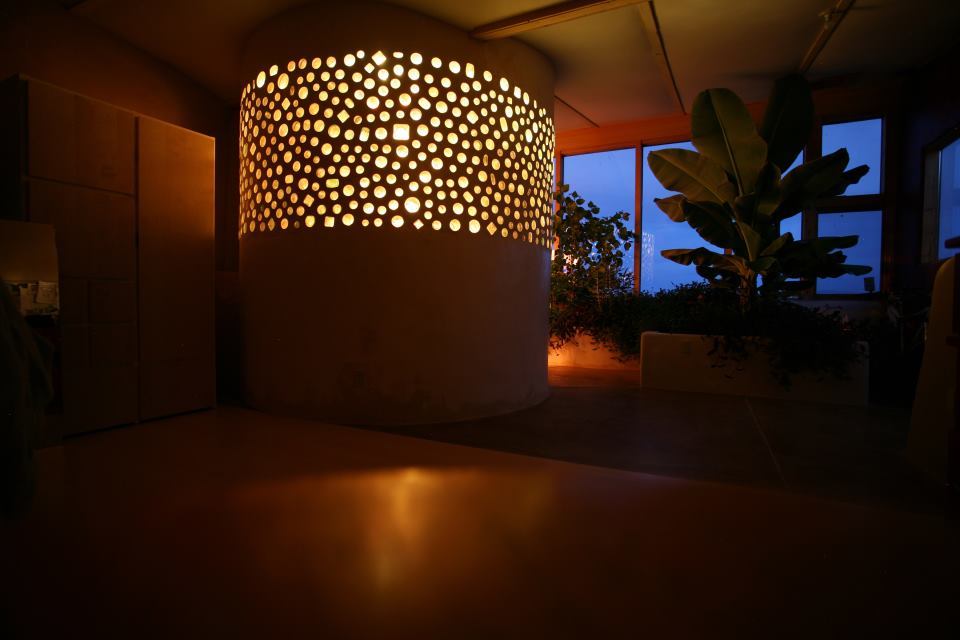
Bottles... as bricks? WTF? Well, first, that needs to be qalified- no, you don't just slap some concrete on a bottle and call it a brick. What actually happens to make these is that the neck and shoulder of two matching bottles are cut off, the resulting 'cups' of the bottom of the bottle are washed and dried, and then they are put top-to-top and the seam between them is wrapped in duct tape, creating a hollow cylindrical 'brick'.
The way these 'bottle bricks' get used is NOT as a structural component, but rather as a weight-reducing component. By adding a bottle to a cob, adobe, or cement wall, you are reducing the amount of mass required to make that wall, and reducing the weight of the wall at the same time. By using bottle bricks to do this, you can arrange them in patterns, constellations, and even make what look like mosaics of stained glass. The effect of sunlight on a brown bottle such as a beer bottle is to render them a red-orange; green glass becomes a more brilliant shade of emerald. And so, even though these are sourced from discarded materials, they result is an easy to make and aesthetically pleasing little jewel of a window that can let additional light into your house while making it lighter and more structurally sound. These are particularly popular in bathrooms, where more light but less outside visibility is usually desirable.
 |
| Plastic bottle bricks being laid in Kenya. |
Then what about can walls? what about plastic bottles? These are essentially the same idea- reducing the total input of building material, reducing the total weight of the wall- and by dint of using disposable garbage to take up the space that various sorts of mud might otherwise have to occupy. Aluminium drink cans, particularly, tend to have solid uniform bottoms and tops, and these make for very good building materials that it is possible to make very interesting geometric patterns, while plastic bottles have the advantage of being very easy to work with using even simply a knife, and some of the more environmentally conscious earthshippers have taken to filling these plastic bottles with additional volumes of plastic garbage to use it up, dispose of it, and create denser filling material all in one go.

Collecting Rainwater is the next concept to understand. In an Earthship, rain water is harvested via the gutters funnelling the rain that lands on the roof into a filtration and storage system that stores a finite portion of all rain that lands on the house. If the system fills to capacity, it simply does not store any more and the rain flows off the house and over the collection onto the ground and into the water table as it normally would, without interruption.
Once rain water is collected, there are four primary uses for it. First, it is filtered and made available to the primary treated water plumbing of the house, to be available for drinking, cooking, etc. Second, the water that goes down the drain from this is fed into the green house at the south side of the house. Third, once it has fed the botanical cell there (which removes the solids and organic compounds from the water), it is used as the water to flush the toilet for the house septic system. Fourth, once it has been flushed, it is put into a septic digester to first sterilize and break the amonia compounds down into nitrates and nitrites, and then this resulting nutrient mixture is pumped into a botanical cell outside the house, where it can be used to drive landscaping or can be used for further gardening, from a contained cell that will not pollute the water table or lose moisture content too rapidly if the water table is too low, such as in especially arid regions.
Food Production, and what the heck is a "Botanical Cell"? So, in the green house, the premise is that a deliberately engineered human ecosystem can passively do the work that would otherwise require machines, investment, and human labor: they can clean shit out of water, for given values of 'clean' and 'shit'.
What does this mean? It means that, in the area that is the entrance to these houses, no matter what the climate or weather might be outside, there is usually a garden that is established around the time the house is built which continues to produce indefinitely. I have seen banana trees, fig trees, tomatoes, strawberries, all manners of herb and spice, and many other things grown in such settings. Because the green house is the portion of the house which collects and accumulates heat to drive the passive heating (and cooling) systems, keeping plants- even tropical plants- at temperatures which they will produce fruit requires no action to be taken after planting. Since it is an indoor environment, there isn't weeding to do; as long as there is somebody at the location occasionally using the sink and flushing the toilet, there will be water delivered to these botanical cells- no manual watering is ever required.
The outdoor botanical cells are essentially the same idea, but are separated because the source of the water is from the black water / septic system. It isn't that there is no capacity to clean this to the point that it couldn't be used indoors, but as a way of meeting code, preventing problems associated with clogs and backups, even though these work essentially the same way, the one inside the earth ship is usually just cleaning soap and tooth paste out of the water, rather than less savory components.
This is the tip of a very large iceberg.
To illustrate what urban food production looks like, lets take tomato plants. In an environment that supports them in doing so, they will grow indefinitely. A well established year-old tomato plant, producing beef steak tomatoes, will produce them in bunches of what look, at first glance, exactly like cherry tomato bunches, with each tomato being 10 times the size of a cherry tomato. Here's one that's 50 weeks old (two weeks short of a year), 24 feet long, still producing fruit, and still growing, pointed out about halfway through this video. Check it out.
Further Data:
- Garbage Warrior, a documentary that was made to comprehensively explain this topic by the actual Earthship people. On Yootoob here.
- A house tour, to give some context to what a conventional function-first earthship would look something like
- Here is an excellent look at some of the features, design principles, and operating constraints of the building methods described here.
Thursday, February 11, 2016
Losing my virginity in Kon Kaen- Part 1
This summary is not available. Please
click here to view the post.
Friday, December 4, 2015
The logistics of spouse abuse: a primer on asymmetric warfare
How does it go? Here is a rough progression of how it went for me.
I am a large white man. I currently stand 5'11" and weigh approximately 300 lbs. The smallest I have been in 10 years is 260 lbs. I was abused by a 5 foot 80 lbs Thai woman.
How <the fuck>?
See, here's the logic. I'm a big guy, and besides being absurdly fat, I'm pretty strong. Therefore, if the police are called, and it comes to light that I have hit a Thai woman, I'm pretty fucked. Since it's not us, but our annoyed neighbors, who might also call, I don't yell back. Because I don't have a visa, if this woman calls the cops, I will go to prison. It's no good that I speak Thai, and can probably sweet talk my way to a bribe and a bit of mercy; if you can't pay the bribe, you can't buy the mercy.
And by this point, not only were we in business together, we'd had the first of our two children, and she'd been diagnosed with HIV- and I'd stayed with her, despite the obvious difficulties this caused.
In case it's not clear from the outset, I was and am an idiot, but I try to have good reasons for the things I do.
At the time this decision was first made, I was intensely and stupidly devoted to the Christian cult. When the positive diagnosis was first given, they explained that we had the option of having an abortion, and explained that with treatment, about 80% of the children born under these circumstances are uninfected. This takes into consideration the administration of antiretroviral drugs, and a special C- section surgery wherein the fetus and placenta are removed without rupturing the placenta, thereby not exposing the baby to any of its mother's infected blood.
<The placenta is a blood barrier, in case you're wondering about that; mother and child don't share blood. This is how a mother can give birth to a baby with a different blood type.>
All this spins in your head when you're doing the math and realizing your kid has a 1:5 chance of being fucked on the first day and living barely a few short miserable years, just the way I'd seen happening in some of the orphanages I'd volunteered at years earlier.
and through all this, my mind centered on the observation that the odds of surviving abortion are 0%, not 80.
And in that moment, my commitment was made. This was the woman I loved, she loved me, we were going to try to save some piece of her, even if she herself couldn't go on. So this is the level of commitment that I entered this asymmetric relationship with.We decided to try for the kid so that she could live on in some sense.
Now, here is the setup for asymmetric warfare. I have no status in the country, no degree (because shortly after the initial diagnosis, I drop out of college to run the wine company she'd started and dragged me into. We do well financially for a little while. Then we have a fight, she insists she's caught me cheating via a conversation I had online with someone else. We have a big falling out, I resign myself to losing my son and the love of my life (as I still thought of her), and then she takes me back.
So, this is how it begins. I am at her mercy to begin with, and then I am in this position as a result of it. If this were jujitsu, this move would be banned from competition sparring for being too dangerous. it's a neck-breaking choke hold.
and so when the blows started falling, I bore it. When she kicked me out and called the cops- threatening me with prison, for imagined offenses, or over trifles- well, what choice did I have? I could bear this, even though I hated it, because I knew she had loved me, and even if she didn't, well, I loved our son enough to stay and take care of him. Or failing that, at least see that he was fed and educated.
So this was the cycle I found myself in. We would fight, she would beat me with whatever she had near her, spit on me, scream, destroy my belongings. Anything she could do to inflict pain, she would do, because she thought she deserved to, or that I deserved to experience it.
So this is how you make someone a zombie. You destroy their ability to be happy. You lure them back, and you destroy their ability to believe in happiness. You've fucked yourself, this is how the story ends.
It already can't get worse- and then it does. And if it isn't because they themselves made it worse, then the things that made it worse stay that bad because the other person never moves on. So no sex becomes no touching.
So I threw myself into work, when I could. I made several interrupted attempts at starting my own companies, the last iteration of which I am currently <dec 2015> reconstructing as the "cure for piracy". Which, yes, is bullshit marketing, but the idea is to make people think, because I think that if this thing were properly used, it might, no matter who made it. It might even have potential for addressing how to cure poverty, but that may be pushing my luck just to mention.
Which I was learning to make in Django 1.3 <edited 2.11.16 to correct information>. And then it was destroyed in front of me by this woman, because I hadn't immediately responded to her comment when I was reading my email.
Fortunately, I was able to sell the pieces <of the laptop she smashed> for $20 as scrap to pay our electric bill and get our lights turned back on, so we could cook our stolen chicken breast and make our stolen milk formula for the kids. And of COURSE during all of this mother has gotten and lost by pawning two computers, a brand new top-of-the-line ipad 2, a car, and gold coins given to us to keep for the kids by my parents.
At about this time period, she attempted to have an affair, and was sending pictures of herself with our children to the other guy; then she tells me, and I, of course, try to figure out who the fuck this other guy is, and eventually catch her using some black magic stuff I can't talk about (sh!), which mainly involved googling the emails I saw in a shared account and figuring out that it seemed like an OK guy, and I didn't want to be an asshole, and this looked like an exit for me- and so I basically emailed and said "yo, I exist, did you know about this?" and she flipped her shit, dropped him, and we got back together so hard it hurt- something I tend to attribute to borderline personality disorder, but I can't make that diagnosis.
But in the middle of this, at about the time she destroys what I genuinely consider to be the beginnings of my life's work, she kicks me out of the house and gets me fired from my job, roughly a day apart. I stay in a hotel room I can afford for the week, if I don't have food. I return the following day, every day, to bring them <stolen> groceries, she won't let the kids near me. It's about this time, I think, that she starts telling my son to call me "Ken" instead of "dad".
Because it gets worse and then it stays that bad.
Right up until the moment you decide to escape. By then you may be at the bottom of an ocean of fear and doubt, but at least you know which way is up.
I am a large white man. I currently stand 5'11" and weigh approximately 300 lbs. The smallest I have been in 10 years is 260 lbs. I was abused by a 5 foot 80 lbs Thai woman.
How <the fuck>?
See, here's the logic. I'm a big guy, and besides being absurdly fat, I'm pretty strong. Therefore, if the police are called, and it comes to light that I have hit a Thai woman, I'm pretty fucked. Since it's not us, but our annoyed neighbors, who might also call, I don't yell back. Because I don't have a visa, if this woman calls the cops, I will go to prison. It's no good that I speak Thai, and can probably sweet talk my way to a bribe and a bit of mercy; if you can't pay the bribe, you can't buy the mercy.
And by this point, not only were we in business together, we'd had the first of our two children, and she'd been diagnosed with HIV- and I'd stayed with her, despite the obvious difficulties this caused.
In case it's not clear from the outset, I was and am an idiot, but I try to have good reasons for the things I do.
At the time this decision was first made, I was intensely and stupidly devoted to the Christian cult. When the positive diagnosis was first given, they explained that we had the option of having an abortion, and explained that with treatment, about 80% of the children born under these circumstances are uninfected. This takes into consideration the administration of antiretroviral drugs, and a special C- section surgery wherein the fetus and placenta are removed without rupturing the placenta, thereby not exposing the baby to any of its mother's infected blood.
<The placenta is a blood barrier, in case you're wondering about that; mother and child don't share blood. This is how a mother can give birth to a baby with a different blood type.>
All this spins in your head when you're doing the math and realizing your kid has a 1:5 chance of being fucked on the first day and living barely a few short miserable years, just the way I'd seen happening in some of the orphanages I'd volunteered at years earlier.
and through all this, my mind centered on the observation that the odds of surviving abortion are 0%, not 80.
And in that moment, my commitment was made. This was the woman I loved, she loved me, we were going to try to save some piece of her, even if she herself couldn't go on. So this is the level of commitment that I entered this asymmetric relationship with.We decided to try for the kid so that she could live on in some sense.
Now, here is the setup for asymmetric warfare. I have no status in the country, no degree (because shortly after the initial diagnosis, I drop out of college to run the wine company she'd started and dragged me into. We do well financially for a little while. Then we have a fight, she insists she's caught me cheating via a conversation I had online with someone else. We have a big falling out, I resign myself to losing my son and the love of my life (as I still thought of her), and then she takes me back.
So, this is how it begins. I am at her mercy to begin with, and then I am in this position as a result of it. If this were jujitsu, this move would be banned from competition sparring for being too dangerous. it's a neck-breaking choke hold.
and so when the blows started falling, I bore it. When she kicked me out and called the cops- threatening me with prison, for imagined offenses, or over trifles- well, what choice did I have? I could bear this, even though I hated it, because I knew she had loved me, and even if she didn't, well, I loved our son enough to stay and take care of him. Or failing that, at least see that he was fed and educated.
So this was the cycle I found myself in. We would fight, she would beat me with whatever she had near her, spit on me, scream, destroy my belongings. Anything she could do to inflict pain, she would do, because she thought she deserved to, or that I deserved to experience it.
So this is how you make someone a zombie. You destroy their ability to be happy. You lure them back, and you destroy their ability to believe in happiness. You've fucked yourself, this is how the story ends.
It already can't get worse- and then it does. And if it isn't because they themselves made it worse, then the things that made it worse stay that bad because the other person never moves on. So no sex becomes no touching.
So I threw myself into work, when I could. I made several interrupted attempts at starting my own companies, the last iteration of which I am currently <dec 2015> reconstructing as the "cure for piracy". Which, yes, is bullshit marketing, but the idea is to make people think, because I think that if this thing were properly used, it might, no matter who made it. It might even have potential for addressing how to cure poverty, but that may be pushing my luck just to mention.
Which I was learning to make in Django 1.3 <edited 2.11.16 to correct information>. And then it was destroyed in front of me by this woman, because I hadn't immediately responded to her comment when I was reading my email.
Fortunately, I was able to sell the pieces <of the laptop she smashed> for $20 as scrap to pay our electric bill and get our lights turned back on, so we could cook our stolen chicken breast and make our stolen milk formula for the kids. And of COURSE during all of this mother has gotten and lost by pawning two computers, a brand new top-of-the-line ipad 2, a car, and gold coins given to us to keep for the kids by my parents.
At about this time period, she attempted to have an affair, and was sending pictures of herself with our children to the other guy; then she tells me, and I, of course, try to figure out who the fuck this other guy is, and eventually catch her using some black magic stuff I can't talk about (sh!), which mainly involved googling the emails I saw in a shared account and figuring out that it seemed like an OK guy, and I didn't want to be an asshole, and this looked like an exit for me- and so I basically emailed and said "yo, I exist, did you know about this?" and she flipped her shit, dropped him, and we got back together so hard it hurt- something I tend to attribute to borderline personality disorder, but I can't make that diagnosis.
But in the middle of this, at about the time she destroys what I genuinely consider to be the beginnings of my life's work, she kicks me out of the house and gets me fired from my job, roughly a day apart. I stay in a hotel room I can afford for the week, if I don't have food. I return the following day, every day, to bring them <stolen> groceries, she won't let the kids near me. It's about this time, I think, that she starts telling my son to call me "Ken" instead of "dad".
Because it gets worse and then it stays that bad.
Right up until the moment you decide to escape. By then you may be at the bottom of an ocean of fear and doubt, but at least you know which way is up.
Sunday, November 29, 2015
Harajuku moments- or How Tim Ferriss saved my life Twice.
This is a piece I wrote for my blog tracking my weight loss. I haven't updated it in over a year, but this part of my biography, I guess, so it kinda fits here. I have put the dates of time periods referenced in {curly braces} to make putting a timeline together more simple.
For reference, I have now spent approximately 2 years doing this diet, and will continue it <or something like it> for the rest of my life because it is a very usable "best practice", and without extraneous effort I have lost approximately 56 lbs this year {2015} and am over halfway to a normal size, without making a single sacrifice. I've had every cookie I've wanted in the last two years. I've just gotten smarter about how to want them.
Tim Ferriss, if you ever read this, this is a brief synopsis of why you have a permanent standing offer of equity <in the companies that will be formed to do this>, should you ever be interested.
A “Harajuku Moment” is the moment when something changes from being ‘nice to have’ and becomes 'necessary to survive’. {Edit 11/15: a better definition of "harajuku moment" might be "the moment when a decision can no longer be avoided", or "the moment that changes everything"}
For reference, I have now spent approximately 2 years doing this diet, and will continue it <or something like it> for the rest of my life because it is a very usable "best practice", and without extraneous effort I have lost approximately 56 lbs this year {2015} and am over halfway to a normal size, without making a single sacrifice. I've had every cookie I've wanted in the last two years. I've just gotten smarter about how to want them.
Tim Ferriss, if you ever read this, this is a brief synopsis of why you have a permanent standing offer of equity <in the companies that will be formed to do this>, should you ever be interested.
A “Harajuku Moment” is the moment when something changes from being ‘nice to have’ and becomes 'necessary to survive’. {Edit 11/15: a better definition of "harajuku moment" might be "the moment when a decision can no longer be avoided", or "the moment that changes everything"}
For me, with weight specifically, I’ve had two of these.
The first was in Thailand, about 6-8 months ago {2012-13}. I was living in poverty in Thailand, stealing food to survive, and I had the good fortune to steal a couple of books. You can read more about this in the link I posted, but the gist of it is that I stole a handful of books, including the Song of Ice and Fire series by George Martin (every book except “A Dance With Dragons”), a book called “The Game” by Neil Strauss, and I got the 4 Hour Work Week, by Tim Ferriss.
I knew within 20 minutes of opening the 4HWW that this book would forever change the course of my life.
See, there are two important parts of the 4HWW. The first deals with something called “Fearsetting”, and the second is something called “Dreamlining”. The second is about setting goals you care about; and the first is about dealing with and mitigating all the things that make you give up on those goals.
So the dreamlining was something I was immediately drawn to. My life, at this point, had nothing but fantasy that was appealing about it. I was having panic attacks several times a week, and I was making half-hearted suicide attempts regularly, usually stopping myself in time to survive by reminding myself that my kids would be left uncared for, because their mother- who I was living with, who was crazy, and who hated/hates me and wanted/wants me to die, has HIV- and she’s an HIV denialist who thinks the whole thing is a conspiracy, and so she refuses to be treated for it.
So this was a situation I wanted no part of, but for a variety of reasons- my lack of legal status in the country, lack of financial independence, commitment to the kids- this was a situation I didn’t see a way out of.
When I first started dreamlining, two things happened. First, it took me out of my shitty existence and let me see, clearly, what the real possibilities were and are- much of the book covers practical tools and methods of achieving various goals. Second, it made continuing this existence even more unbearable, because now I could see what was outside it.
The fearsetting exercises were the nails in the coffin. Because of these, I methodically went through and identified the individual specific things I was afraid of and came up with strategies to avoid these and deal with them. I was afraid of my ex trying to hurt or even kill me: I developed strategies to deal with this. I was worried about the kids and keeping them away from her: this was dealt with. I was worried about her trying to sabotage my future efforts: I decided to be as open and honest as possible about what had happened, and it rapidly became clear to people that she was mentally unstable.
So this was the first “Harajuku snowball”. This led me to realize that I did want to lose 100 lbs. I did want to try doing stand-up comedy. I did want to start a tech startup and make millions of dollars on a piece of technology that would make the world a better place. and I did not want to continue this shitty life instead of reaching those goals.
And so I reached out to my family. They paid for my kids citizenship- in both countries- and their passports, also in both countries- and then they bought tickets for all of us (but the terrible ex) to come home.
My second Harajuku moment came 2 months later, over Christmas. I was gorging on sweets, guzzling eggnog, and getting drunk on cheap box wine every day. A couple times, I bought a giant bag of butterfinger bars and ate the whole bag in one sitting. When my mother made pies for a couple of friends who came over, I stole almost an entire pie. I was just going nuts, and I was watching my waistline explode.
And then, one day, I’d just had enough. I knew I needed to stop dicking around and get a plan of action or I was never going to escape from this- the situation I’m still in- and I had to admit that I needed to start doing *something*.
So I had just downloaded a lot of ebooks on various topics- I got some things on hypnosis, I got a copy of '50 shades of grey’, and I got a digital copy of 4hww. When I got that last one, I found a new book: the 4-hour body. Same author and everything- so I figured, “Why the fuck not?” and pirated that, too. I kind of played with the idea of the author being some kind of fucking schmexpert who’d had one successful book about one topic and figured he could do a book about anything else and that would by successful too, but I could at least read it for laughs before moving on to something more conventional and proven, like the body-for-life program or keto or whatever.
I should mention that I do have a somewhat extensive history of trying different diets. I did weight watchers as a teenager, and so I have some idea of what it means to control portions into manageable quantities, even without counting calories (at the time, the 'point’ system allotted a certain number of points per day, with points calculated by fat, carbohydrate, fiber, and sodium content, among other things). I did body for life a few years later- in my delusional attempt at becoming a navy SEAL, and under the guidance of one of my father’s good friends, who is a genius-level fitness nut and a high-ranking Jujitsu practitioner and so on- and I made some impressive gains (and losses) with that. I know that it’s possible to lose 10-20 lbs a week, because I did this on weight watchers. I know it’s possible to gain strength very quickly, because- at 320 lbs- I was doing sets of 6 pullups from a starting point of not even being able to hang onto the pullup bar for 10 seconds a year (or less?) earlier. When I first moved to Thailand, I lost approximately 60 lbs in the course of about 2 months, and kept it off for two years with no problem.
So when I opened 4hb and saw the same kinds of things I’d seen in myself, I wasn’t surprised by their claims, but by their compiled presence, and the presence (and claims) of things I hadn’t seen before.
And I knew: here was a way for me to go back to these kinds of results, with a cohesive set of described behaviors that would allow me to do different things to reach them.
And in that moment, I knew I no longer had an excuse to be as fat as I was, and so I began.
The first was in Thailand, about 6-8 months ago {2012-13}. I was living in poverty in Thailand, stealing food to survive, and I had the good fortune to steal a couple of books. You can read more about this in the link I posted, but the gist of it is that I stole a handful of books, including the Song of Ice and Fire series by George Martin (every book except “A Dance With Dragons”), a book called “The Game” by Neil Strauss, and I got the 4 Hour Work Week, by Tim Ferriss.
I knew within 20 minutes of opening the 4HWW that this book would forever change the course of my life.
See, there are two important parts of the 4HWW. The first deals with something called “Fearsetting”, and the second is something called “Dreamlining”. The second is about setting goals you care about; and the first is about dealing with and mitigating all the things that make you give up on those goals.
So the dreamlining was something I was immediately drawn to. My life, at this point, had nothing but fantasy that was appealing about it. I was having panic attacks several times a week, and I was making half-hearted suicide attempts regularly, usually stopping myself in time to survive by reminding myself that my kids would be left uncared for, because their mother- who I was living with, who was crazy, and who hated/hates me and wanted/wants me to die, has HIV- and she’s an HIV denialist who thinks the whole thing is a conspiracy, and so she refuses to be treated for it.
So this was a situation I wanted no part of, but for a variety of reasons- my lack of legal status in the country, lack of financial independence, commitment to the kids- this was a situation I didn’t see a way out of.
When I first started dreamlining, two things happened. First, it took me out of my shitty existence and let me see, clearly, what the real possibilities were and are- much of the book covers practical tools and methods of achieving various goals. Second, it made continuing this existence even more unbearable, because now I could see what was outside it.
The fearsetting exercises were the nails in the coffin. Because of these, I methodically went through and identified the individual specific things I was afraid of and came up with strategies to avoid these and deal with them. I was afraid of my ex trying to hurt or even kill me: I developed strategies to deal with this. I was worried about the kids and keeping them away from her: this was dealt with. I was worried about her trying to sabotage my future efforts: I decided to be as open and honest as possible about what had happened, and it rapidly became clear to people that she was mentally unstable.
So this was the first “Harajuku snowball”. This led me to realize that I did want to lose 100 lbs. I did want to try doing stand-up comedy. I did want to start a tech startup and make millions of dollars on a piece of technology that would make the world a better place. and I did not want to continue this shitty life instead of reaching those goals.
And so I reached out to my family. They paid for my kids citizenship- in both countries- and their passports, also in both countries- and then they bought tickets for all of us (but the terrible ex) to come home.
My second Harajuku moment came 2 months later, over Christmas. I was gorging on sweets, guzzling eggnog, and getting drunk on cheap box wine every day. A couple times, I bought a giant bag of butterfinger bars and ate the whole bag in one sitting. When my mother made pies for a couple of friends who came over, I stole almost an entire pie. I was just going nuts, and I was watching my waistline explode.
And then, one day, I’d just had enough. I knew I needed to stop dicking around and get a plan of action or I was never going to escape from this- the situation I’m still in- and I had to admit that I needed to start doing *something*.
So I had just downloaded a lot of ebooks on various topics- I got some things on hypnosis, I got a copy of '50 shades of grey’, and I got a digital copy of 4hww. When I got that last one, I found a new book: the 4-hour body. Same author and everything- so I figured, “Why the fuck not?” and pirated that, too. I kind of played with the idea of the author being some kind of fucking schmexpert who’d had one successful book about one topic and figured he could do a book about anything else and that would by successful too, but I could at least read it for laughs before moving on to something more conventional and proven, like the body-for-life program or keto or whatever.
I should mention that I do have a somewhat extensive history of trying different diets. I did weight watchers as a teenager, and so I have some idea of what it means to control portions into manageable quantities, even without counting calories (at the time, the 'point’ system allotted a certain number of points per day, with points calculated by fat, carbohydrate, fiber, and sodium content, among other things). I did body for life a few years later- in my delusional attempt at becoming a navy SEAL, and under the guidance of one of my father’s good friends, who is a genius-level fitness nut and a high-ranking Jujitsu practitioner and so on- and I made some impressive gains (and losses) with that. I know that it’s possible to lose 10-20 lbs a week, because I did this on weight watchers. I know it’s possible to gain strength very quickly, because- at 320 lbs- I was doing sets of 6 pullups from a starting point of not even being able to hang onto the pullup bar for 10 seconds a year (or less?) earlier. When I first moved to Thailand, I lost approximately 60 lbs in the course of about 2 months, and kept it off for two years with no problem.
So when I opened 4hb and saw the same kinds of things I’d seen in myself, I wasn’t surprised by their claims, but by their compiled presence, and the presence (and claims) of things I hadn’t seen before.
And I knew: here was a way for me to go back to these kinds of results, with a cohesive set of described behaviors that would allow me to do different things to reach them.
And in that moment, I knew I no longer had an excuse to be as fat as I was, and so I began.
Monday, November 23, 2015
Being the Atheist in a Christian Family
The following is a letter I sent to my father, to explain why there was no chance of my kids going to "Vacation Bible School" (A triple oxymoron if ever there was one). This nearly led to a shouting match- but this email managed to clear the air quite well, hence I am reproducing it here, for future reference.
To preserve some privacy for the people mentioned, I have changed names to animals.
Hi Dad,
I wrote this out thinking I'd send it to
you and mom first, but I figure it's a safer bet to send it to you
first, to avoid any conflicts.
So, we had a good talk the other day, but one thing that's very clear is you guys have no idea what I think. I don't want to inflict most of it on anybody, because everybody needs to sleep at night, but I figure I can give you guys the broad strokes in 5 bullet points, with a brief description of how and why I came to these conclusions or reached these decisions, so that you guys can actually address my concerns.
- I don't have beliefs, because I've philosophically rejected the validity of 'belief' as a concept.
Simply put, belief does not make a thing true, and disbelief does not
make a thing false. At best, you believe something true- in which case
the belief is spurious. At worst, you believe something false- and so
the belief, itself, is the barrier to understanding. So instead of this,
I try to have data and knowledge (the 'who', 'what', 'where', 'how much/many', and 'when') and understanding (the 'how' and 'why'). I don't believe
in the 'big bang', or in evolution, or even that I'm sitting at the
kitchen table typing this out for you guys. It is enough for me to
accept that the evidince is that these things seem to be the case, no
matter what I think of them, and that it is my duty- if I care- to know
or understand them, rather than to simply tell myself- or anyone else-
they are true or false.
This has a corollary- I also reject the validity of any faith, which I define as "the assertion of the truth without or in spite of reason or evidence". But "Faith" in the English language has many uses beyond this meaning- most frequently things like "loyalty", "trust", etc- and I don't reject these things, but I try to use these more specific words instead. - I stopped being Christian because it's no longer possible, knowing what I know, to accept that it might be true.
There are mountains of evidence and lots of reasons against what you
believe. These are the things I've been "strident" about- Biblical
contradictions, inaccuracies, forgeries, and apparent lies told for
political gain by the factions of the authors, archaeological evidence,
Historical records, etc. Going through all of this was a very painful
but eye-opening process. So my position could be stated as saying
"Whether there is a god or not, it isn't that one". But I don't hate
Christianity, in the same way that you don't hate any other religion. I
just think it's factually incorrect. I don't hate Christians; you've
got good reasons to think and act the way you do, like all of the social
factors- for example, being able to still talk to your parents
<mom> without them thinking you must be 'evil' or 'spiritually
deficient'. But I don't think these reasons contribute meaningfully to
the truth of the claims of Christianity.
Also important: Nothing bad happened to cause this. I still actively pursue the study of biblical topics - hence mentioning {reading} Josh McDowell's books, and CS Lewis, among others. But I think the best available lesson from any of these is how to think, not what to think. Believing in God gave me an additional coping mechanism for things like Dog's diagnosis- "God doesn't give you what you can't handle" - and was a source of hope in some very dark situations. Nobody's 'misbehavior' caused me to doubt. I have a lot of respect for how you handle your beliefs, and for the rigor that Bear has, and the dedication that Dr. Pigeon in Thailand has, and as much for many other people you don't know about. But none of these have any effect on whether or not the beliefs are true, and in the end, that simply mattered more to me. And so I eventually had to confront the growing case against Christianity that I had been becoming more aware of and knowledgable about for years. By now you should have noticed the result of that, but I'm deliberately cutting out the data here because I know you guys don't want to hear it.
Last sub-point about this: I'm not committed to the idea that Christianity is false, but if there is a case to be made for it, this case must also account for the evidence and reasons I've found against it; calling it all a "trick of Satan" simply doesn't cut it. Maybe there are evidence and reasons I don't know about, and if I find them, and they do account for what I've found, I've got nothing against reconverting- but at this point, I'm not holding my breath. - I'm a materialist, in the sense that I think things that don't exist don't exist.
Maybe there is something beyond this natural universe; but there hasn't
been any convincing evidence I've been able to discover that can't be
better understood some other way. But I also think that what we are is
not all we can be, and that it's all about how you use the substance of
yourself and your environment before you die that allows for the best
set of possibilities. Even if we were just computers, computers are
still amazing machines that can do awesome things, and the first step
towards upgrading is knowing how to upgrade.
As a sub-heading, I think the materialistic explanations for religious experience are more sensible than the supernatural explanations. It makes more sense to me that religious experience happens because human brains are amazing but imperfect machines, than to think that there are armies of demons running around putting on skits to dupe people into hell. - I'm an atheist, not a nihilist. I think that everybody has to find or make their own purpose, even Christians. Chipmunk is way
more nihilistic than me; hence, he sees no problem with taking the kids
to church, since everybody will die anyway. I think what little time
we've got here shouldn't be wasted on it, because none of us will get
more time here, and the consequences simply don't justify it; At the
very least, this means we agree that church is more than just free
babysitting.
- I'm neither amoral nor immoral. Morality, even yours, is determined by consequences, as these affect happiness, well-being, and free self-determination of conscious entities capable of meaningfully experiencing these things.
This is why it's more important to not step on an ant than to not step
on a rock; because the ant can actally feel it. All we disagree on is when
the consequences occur: you think that the only ones that matter - the
'ultimate' consequences- happen after we die, in Heaven or Hell, and I
think that death is the end of that for you, because by definition,
there's no 'you' left to experience anything more.
This one chafes, by the way. I've raped and murdered all I want. The amount I want is zero. If the only thing stopping you from doing that is fear of hell, you're just not a good person. Christianity doesn't give you 'moral superpowers', and it's insulting when you act like you're somehow the only ones capable of realizing if something is right or wrong. There's no action I've found that a believer could do that an unbeliever couldn't; but religion, yours and everyone else's, can make morally normal people say and do disgisting and wicked things that nobody would otherwise consider. I was circumcised to 'prevent yeast infections' hundreds of years after the invention of soap, because that was the treatment in the tribe you are loyal to- but that's like 'treating' sprained ankles by amputating legs. Being offended by this isn't 'vehemence', and speaking against things like it isn't 'stridence'. I just want us to all be reasonable, and I think these ideas aren't, that you guys (usually) are, and that we can work through this rationally.
An equivalent that might help you understand would be if you were visiting a Muslim's house and they had you kneel on the floor to pray before dinner; it's not your faith, it's theirs, and you can respect them and kneel, but they shouldn't take that to mean they can drag you to the mosque afterwards, or that they'll be doing you a favor by taking your kids there when you've told them you're not comfortable with it. I think I remember Mom turning down similar 'invitations' when I was Vince's age, for the same reasons.
Last, I want to reiterate that I love you guys. I don't think you're deficient parents in any way, I just disagree with you about your religion, and that's it.
Friday, November 20, 2015
Coffee with Warlords
It begins, as any story might, with me absent-mindedly doodling a submachine gun in the margins of a notebook, after my weekly English tutorials with my tribal refugee neighbors in Thailand, only to hear from over my shoulder a rather delighted-sounding "Oh! My cousin's army could use such a gun! Can you make it for them?"
Now, for those of you just joining this story, a bit more needs to be done to properly set the scene. This is late 2006 or possibly early 2007, and I'm living and working as a missionary with this sort of tribal minority in Thailand, as well as with orphans and kids who couldn't be raised by their family- of those, approximately half were in the orphan/hostels because they had family members with HIV, and virtually all were tribal minorities who were in Thailand in the first place because they <or their parents> had either been involved in drug smuggling from Burma to Thailand, were refugees from ethnic cleansing that was happening there, or both.
Being a missionary, I saw my work as God's work, and was devoted to bringing peace and prosperity and Jesus Christ to these people- virtually all of whom were already Christian enough to be uninterested in being converted again. But I was clever, and figured I could at least materially assist the "peace and prosperity" stuff, since that's all physically possible and mostly just a matter of getting things done.
But it was around this time that I was formulating my early ideas of both what is possible and what is beneficial in terms of raising the standards of living for subsistence hunters and farmers, living under occupation and with the direct threat of violence on a day to day basis.
Much of this is still not widely known. What you can probably find out, via sources like Google and Wikipedia, is that Burma had been a British colony which was basically shoved out of the Empire after world war 2 and nearly a decade of war and occupation by the Japanese, whereupon it promptly collapsed and entered what is still the longest civil war in history- as I sit here writing this, I'm fairly certain that whether it has been declared finished or not, there are still nationalist movements among the tribal groups I worked with, and I very much doubt that they know or care that the Burmese soldiers technically no longer have legal orders to shoot them on sight- and I'd be very surprised if the Burmese soldiers know or care either, being that the majority of them were tribal children who were forced conscripts into the same battalions that killed their families. {Edit for clarity: the "most Burmese soldiers started out as child conscripts" statement refers specifically to how the Burmese army operated in the tribal lands it was trying to re-capture, and does not describe the Burmese army in general}
Footnote: If you want to get a good picture of the sort of news clipping I saw on a day-to-day basis, there is a missionary group called Free Burma Rangers which trains paramedics in the tribal groups on the Thai border with Burma to deliver basic medical treatment to all of the villages they can reach.
The Burman ethnic group has a long and bloody history as a military power, and this is particularly the view of the Thai people, who have seen their borders shift over the centuries as the Thai and Burmans squabble over the same land and towns, with the Burmese occupying much of what is now northern Thailand for nearly 300 years, including Chiang Mai- the city I lived in. And the end of occupation saw the revival of these traditions, with the aid of modern weapons.
So it should make perfect sense when I tell you that, as a policy of self defense, and with the aid of the US weapons that the Thai government was receiving as part of their compensation for the anti-communist collaboration with the American military during the Vietnam war, the Thai government began arming all of the tribal groups along the Burmese side of its' border as a way of denying the ability to operate freely, and ths threaten the Thai border, to the various centralized Burman governments that rose and fell from the same ashes.
Now that the stage is somewhat set, what happened to his cousin's army?
Well, as it turned out, it wasn't much of an army- at various times, numbers ranging from 50-300 were thrown out as estimates of the number of their soldiers. The conversation was mostly bullshit- I was in no position to be offering material assistance to any military effort, and had nothing to tell them that was useful. After that English lesson, me and this person- I'll call him "Andrew", because he had such an "English name" that he had given himself, although it wasn't this one- retired to his house for tea, Jesus music (he sang, and I listened), and a discussion of what materials, machines, and processes were needed to make guns if we were, hypothetically, up in the mountainous regions on the northern border of Myanmar, near China, where the Lisu people have lived for centuries.
It turned out to be an interesting problem, and one that I have spent years thinking about. There is an abundance of raw materials- even scrap metal, often from things such as downed WW2 aircraft that have never been located or salvaged. But there are no tools, or the tools that exist are of poor quality, or are very rudimentary and largely unsuitable for the tasks that firearms manufacture would demand of them.
Some time after this, Andrew told me that he wanted me to meet "his friend" for coffee, because his friend was somebody important in the efforts to resist the crimes against humanity being committed by the Burmese military.
We took a Songthaew- a sort of modified pickup truck that serves as one form of public transport in much of Thailand- to a fancy hotel downtown, mostly so that we wouldn't get wet from the beginnings of the Songkhran festival that marks the start of the new year on the Thai calendar. We arrived a bit late and wandered in, two extremely out-of-place and mismatched characters, into a dark empty cold banquet hall with a few sleepy diners having breakfast in various corners of the room.
The man we met was short, a bit stocky, beginning to bald, and dressed conservatively. We shook hands, and he announced that he wanted to begin with a prayer- and I think I might have prayed too, at his request, but I am not sure about this detail. It was clear that his faith was important to him, and that he wanted mine to be to me.
And then he introduced himself as a general in the Kachin Independence Army.
I can't say I remember the bulk of what was said very vividly- a lot of it was social niceties, especially to start, when he was trying to get a sense of who I was, and so on.
So I chattered away about "how X is made" and "if we could get y to your area, you could do guns AND z"- I think I was trying to sell him on the idea of industrializing these villages, which I'm fairly sure he wasn't interested in, and I'm more sure I wasn't coherently articulating.
But I do remember very clearly what the problem stopping the gun discussion was: there was no shortage of guns, but only of bullets, and the means to reload these. I listened as he described how his soldiers would save spent ammunition casings- the {usually} brass tube-looking things that get spit out the side of the gun when the bullet (the actual projectile) is fired out the front. In his case, these were usually steel casings- nigh on impossible to reuse- and to compound the matter, the only available way to reload them was with homemade gunpowder, which caused the weapons to foul rapidly, leading to jamming. I briefly described to him some of the ways we could go about making better powder, such as nitrocelulose-based smokeless powders- but I didn't know enough chemistry to describe how to get the ingredients necessary to make this.
The last detail I remember very clearly is describing the sort of minimum budget that might be needed to get basic production up and running- I cited the low thousands of dollars, describing the pricing I had seen on machine tools such as lathes and mills.
And this is where the conversation, for me, became unsettling, because money was no object- and my grasp of economics, at the time recently bolstered by my first 'reading' of the <excellent> book "Freakonomics", led me to rapidly conclude that there was no legitimate way that this guy had that kind of money that wasn't fucking somebody up somewhere, and that was something I was unwilling to play ball with.
I am making an effort not to describe things more vividly than I actually remember them, but I remember probing at this gently in our conversation- or as gently as I could, given my very limited social skills, especially at that time- and the responses he gave were also unsettling. This was a man who seemed familiar with giving life and death orders without accountability, and who used his god's authority to do so.
Our business concluded, we exchanged social niceties- overall, it was a very pleasant conversation, although the coffee was terrible- and he gave me his phone number, telling me to call him if I needed absolutely anything. I promptly added his number to my phone- and never called him.
Now, for those of you just joining this story, a bit more needs to be done to properly set the scene. This is late 2006 or possibly early 2007, and I'm living and working as a missionary with this sort of tribal minority in Thailand, as well as with orphans and kids who couldn't be raised by their family- of those, approximately half were in the orphan/hostels because they had family members with HIV, and virtually all were tribal minorities who were in Thailand in the first place because they <or their parents> had either been involved in drug smuggling from Burma to Thailand, were refugees from ethnic cleansing that was happening there, or both.
Being a missionary, I saw my work as God's work, and was devoted to bringing peace and prosperity and Jesus Christ to these people- virtually all of whom were already Christian enough to be uninterested in being converted again. But I was clever, and figured I could at least materially assist the "peace and prosperity" stuff, since that's all physically possible and mostly just a matter of getting things done.
But it was around this time that I was formulating my early ideas of both what is possible and what is beneficial in terms of raising the standards of living for subsistence hunters and farmers, living under occupation and with the direct threat of violence on a day to day basis.
Much of this is still not widely known. What you can probably find out, via sources like Google and Wikipedia, is that Burma had been a British colony which was basically shoved out of the Empire after world war 2 and nearly a decade of war and occupation by the Japanese, whereupon it promptly collapsed and entered what is still the longest civil war in history- as I sit here writing this, I'm fairly certain that whether it has been declared finished or not, there are still nationalist movements among the tribal groups I worked with, and I very much doubt that they know or care that the Burmese soldiers technically no longer have legal orders to shoot them on sight- and I'd be very surprised if the Burmese soldiers know or care either, being that the majority of them were tribal children who were forced conscripts into the same battalions that killed their families. {Edit for clarity: the "most Burmese soldiers started out as child conscripts" statement refers specifically to how the Burmese army operated in the tribal lands it was trying to re-capture, and does not describe the Burmese army in general}
Footnote: If you want to get a good picture of the sort of news clipping I saw on a day-to-day basis, there is a missionary group called Free Burma Rangers which trains paramedics in the tribal groups on the Thai border with Burma to deliver basic medical treatment to all of the villages they can reach.
The Burman ethnic group has a long and bloody history as a military power, and this is particularly the view of the Thai people, who have seen their borders shift over the centuries as the Thai and Burmans squabble over the same land and towns, with the Burmese occupying much of what is now northern Thailand for nearly 300 years, including Chiang Mai- the city I lived in. And the end of occupation saw the revival of these traditions, with the aid of modern weapons.
So it should make perfect sense when I tell you that, as a policy of self defense, and with the aid of the US weapons that the Thai government was receiving as part of their compensation for the anti-communist collaboration with the American military during the Vietnam war, the Thai government began arming all of the tribal groups along the Burmese side of its' border as a way of denying the ability to operate freely, and ths threaten the Thai border, to the various centralized Burman governments that rose and fell from the same ashes.
Now that the stage is somewhat set, what happened to his cousin's army?
Well, as it turned out, it wasn't much of an army- at various times, numbers ranging from 50-300 were thrown out as estimates of the number of their soldiers. The conversation was mostly bullshit- I was in no position to be offering material assistance to any military effort, and had nothing to tell them that was useful. After that English lesson, me and this person- I'll call him "Andrew", because he had such an "English name" that he had given himself, although it wasn't this one- retired to his house for tea, Jesus music (he sang, and I listened), and a discussion of what materials, machines, and processes were needed to make guns if we were, hypothetically, up in the mountainous regions on the northern border of Myanmar, near China, where the Lisu people have lived for centuries.
It turned out to be an interesting problem, and one that I have spent years thinking about. There is an abundance of raw materials- even scrap metal, often from things such as downed WW2 aircraft that have never been located or salvaged. But there are no tools, or the tools that exist are of poor quality, or are very rudimentary and largely unsuitable for the tasks that firearms manufacture would demand of them.
Some time after this, Andrew told me that he wanted me to meet "his friend" for coffee, because his friend was somebody important in the efforts to resist the crimes against humanity being committed by the Burmese military.
We took a Songthaew- a sort of modified pickup truck that serves as one form of public transport in much of Thailand- to a fancy hotel downtown, mostly so that we wouldn't get wet from the beginnings of the Songkhran festival that marks the start of the new year on the Thai calendar. We arrived a bit late and wandered in, two extremely out-of-place and mismatched characters, into a dark empty cold banquet hall with a few sleepy diners having breakfast in various corners of the room.
The man we met was short, a bit stocky, beginning to bald, and dressed conservatively. We shook hands, and he announced that he wanted to begin with a prayer- and I think I might have prayed too, at his request, but I am not sure about this detail. It was clear that his faith was important to him, and that he wanted mine to be to me.
And then he introduced himself as a general in the Kachin Independence Army.
I can't say I remember the bulk of what was said very vividly- a lot of it was social niceties, especially to start, when he was trying to get a sense of who I was, and so on.
So I chattered away about "how X is made" and "if we could get y to your area, you could do guns AND z"- I think I was trying to sell him on the idea of industrializing these villages, which I'm fairly sure he wasn't interested in, and I'm more sure I wasn't coherently articulating.
But I do remember very clearly what the problem stopping the gun discussion was: there was no shortage of guns, but only of bullets, and the means to reload these. I listened as he described how his soldiers would save spent ammunition casings- the {usually} brass tube-looking things that get spit out the side of the gun when the bullet (the actual projectile) is fired out the front. In his case, these were usually steel casings- nigh on impossible to reuse- and to compound the matter, the only available way to reload them was with homemade gunpowder, which caused the weapons to foul rapidly, leading to jamming. I briefly described to him some of the ways we could go about making better powder, such as nitrocelulose-based smokeless powders- but I didn't know enough chemistry to describe how to get the ingredients necessary to make this.
The last detail I remember very clearly is describing the sort of minimum budget that might be needed to get basic production up and running- I cited the low thousands of dollars, describing the pricing I had seen on machine tools such as lathes and mills.
And this is where the conversation, for me, became unsettling, because money was no object- and my grasp of economics, at the time recently bolstered by my first 'reading' of the <excellent> book "Freakonomics", led me to rapidly conclude that there was no legitimate way that this guy had that kind of money that wasn't fucking somebody up somewhere, and that was something I was unwilling to play ball with.
I am making an effort not to describe things more vividly than I actually remember them, but I remember probing at this gently in our conversation- or as gently as I could, given my very limited social skills, especially at that time- and the responses he gave were also unsettling. This was a man who seemed familiar with giving life and death orders without accountability, and who used his god's authority to do so.
Our business concluded, we exchanged social niceties- overall, it was a very pleasant conversation, although the coffee was terrible- and he gave me his phone number, telling me to call him if I needed absolutely anything. I promptly added his number to my phone- and never called him.
Subscribe to:
Posts (Atom)